How Is AI Used in Healthcare Billing and Administration? Benefits, Examples, and What's Next
Healthcare providers manage far more than patient care. Every patient visit involves a complex administrative process, including clinical documentation, medical coding, claim processing, insurance verification, prior authorization, compliance checks, and revenue cycle management.
As healthcare organizations face increasing administrative workloads and complex payer requirements, traditional manual processes can lead to delays, errors, and higher operational costs. Healthcare automation powered by artificial intelligence (AI) is helping providers rethink these workflows and improve the way billing and administrative tasks are managed.
But how exactly is AI being used in healthcare billing and administration, and what benefits can it bring to healthcare providers?
Let’s find out.
What Is AI in Healthcare Billing and Administration?
AI in healthcare billing refers to using artificial intelligence technologies, including machine learning, natural language processing (NLP), and predictive analytics, to automate and improve administrative healthcare processes. Through healthcare workflow automation, AI helps providers streamline complex operational tasks, reduce manual effort, and improve efficiency across billing and administrative workflows.
Traditional billing systems often depend heavily on manual data entry and human review. While experienced billing teams play an essential role, repetitive tasks such as reviewing documentation, assigning codes, checking claim accuracy, and identifying billing errors can consume valuable time.
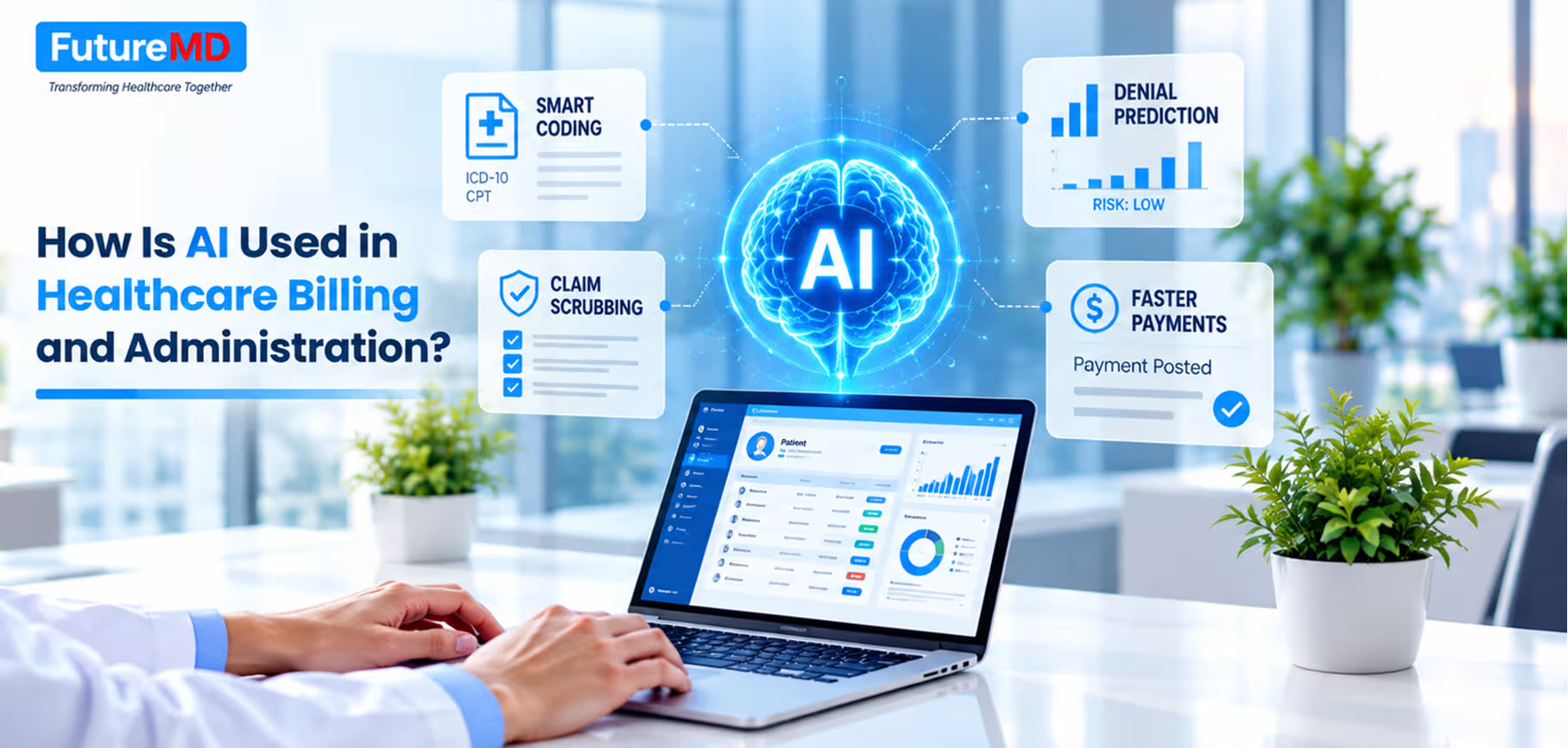
AI-powered medical billing systems analyze large amounts of healthcare data to support tasks such as:
- Medical documentation analysis
- Automated ICD-10, CPT, and HCPCS code suggestions
- Claim validation before submission
- Eligibility and insurance verification
- Denial prediction and management
- Revenue cycle performance analysis
- Compliance monitoring
For healthcare providers, this means fewer administrative bottlenecks, faster claim processing, and better visibility into financial operations.
Why AI Transformation Matters for Healthcare Providers
Medical billing has become increasingly complex due to changing payer requirements, evolving coding guidelines, and stricter compliance standards.
Administrative expenses represent a major portion of healthcare spending, and manual billing processes contribute to these costs. Errors in coding, incomplete documentation, and incorrect claim information can result in delayed payments or claim rejections.
Common challenges healthcare providers face include:
- Claim denials: Incorrect coding, missing documentation, and eligibility issues can prevent successful reimbursement.
- Administrative workload: Billing teams spend significant time reviewing records, correcting errors, and following up on unpaid claims.
- Regulatory complexity: ICD-10, CPT, HCPCS, and payer-specific guidelines require continuous updates and monitoring.
- Revenue delays: Slow claim processing affects cash flow and financial stability.
AI in healthcare billing helps address these challenges by analyzing information faster, identifying potential issues earlier, and supporting more accurate revenue cycle workflows.
How AI Is Used in Medical Billing and Administration
AI in healthcare administration is reshaping the way providers manage complex operational workflows by automated tools that support medical billing teams, improve administrative efficiency, and help healthcare organizations handle tasks more effectively.
1. AI-Assisted Medical Coding
Medical coding is one of the most important areas in which AI is improving healthcare administration.
AI systems use natural language processing (NLP) to analyze clinical notes, physician documentation, and patient records. These systems identify relevant diagnoses, procedures, and medical terminology to assist coders with ICD-10, CPT, and HCPCS code selection.
For example, when a provider documents a patient visit, AI tools can analyze the information and highlight possible coding opportunities, missing documentation, or areas that may require further review. This helps billing teams identify potential issues earlier in the process.
However, AI-generated recommendations still require review by trained medical coding professionals. Certified coders evaluate the documentation, verify code accuracy, and ensure that submitted claims follow payer requirements and healthcare coding guidelines.
For healthcare providers, AI-assisted coding can help:
- Improve coding consistency
- Identify missing documentation
- Reduce manual coding workload
- Support compliance with coding guidelines
FutureMD combines AI technology with certified medical coding professionals to review documentation, maintain coding accuracy, and support reliable claim submissions.
2. Intelligent Claim Validation
Before a claim reaches an insurance payer, AI systems can analyze it for potential errors.
AI-powered claim validation checks for:
- Missing patient information
- Incorrect procedure codes
- Diagnosis and procedure mismatches
- Documentation gaps
- Potential payer-specific issues
By identifying problems before submission, providers can reduce avoidable claim rejections and improve first-pass claim acceptance rates.
This proactive approach allows billing teams to focus on resolving complex cases instead of repeatedly correcting preventable errors.
3. Predictive Analytics for Denial Prevention
Claim denials are a major concern for healthcare organizations because they delay reimbursement and increase administrative workload.
AI-driven predictive analytics review historical billing data to identify patterns associated with denied claims. These systems can recognize risk factors such as:
- Specific payer requirements
- Documentation issues
- Coding inconsistencies
- Eligibility-related problems
Healthcare providers can use these insights to correct issues before claims are submitted, helping strengthen revenue cycle performance.
4. Automated Insurance Eligibility Verification
Insurance eligibility verification is another administrative process where AI provides valuable support.
AI-powered systems can verify patient coverage information, benefits, and payer requirements more efficiently. This helps reduce eligibility-related denials and improves communication between healthcare providers, patients, and insurance companies.
Accurate eligibility verification allows providers to make better financial decisions before delivering services.
5. AI-Based Denial Management
Managing denied claims requires detailed analysis and timely follow-up.
AI systems can categorize denial reasons, prioritize high-value claims, and identify patterns across payer responses. Some platforms can also assist billing teams by generating recommendations for appeal strategies.
Instead of manually reviewing every denial, healthcare providers can use AI insights to improve denial recovery workflows and focus resources where they have the greatest impact.
6. Compliance Monitoring and Quality Control
Healthcare billing must follow strict regulatory requirements. Incorrect coding or incomplete documentation can create compliance risks.
AI-powered compliance tools continuously analyze billing activities and identify potential inconsistencies. These systems support healthcare providers by helping maintain alignment with:
- HIPAA requirements
- Coding standards
- Payer policies
- Documentation guidelines
FutureMD’s AI-assisted medical billing and coding services combine technology with professional oversight to help healthcare organizations maintain accurate and compliant billing practices.
Benefits of AI-Powered Medical Billing for Healthcare Providers
The following are the key benefits:
Improved Revenue Cycle Efficiency
AI reduces manual administrative tasks and helps accelerate billing workflows. Faster coding, improved claim accuracy, and proactive denial prevention allow providers to improve revenue cycle efficiency.
Reduced Administrative Burden
Healthcare professionals should focus more on patient care rather than spending excessive time managing billing corrections and repetitive administrative processes.
AI automation helps billing teams handle routine tasks more efficiently while allowing human experts to focus on complex cases.
Better Coding Accuracy
AI-assisted workflows help identify documentation gaps and coding inconsistencies before claims are submitted. Combined with certified medical coders, AI improves quality control and supports accurate reimbursement.
Faster Claim Processing
Traditional claim processing can take weeks due to manual reviews and corrections. AI-powered workflows help streamline documentation review, coding, and submission processes, reducing unnecessary delays.
Data-Driven Decision Making
AI provides healthcare organizations with insights into claim performance, denial trends, and revenue cycle challenges. These analytics help providers make informed operational decisions.
Limitations of AI in Healthcare Billing
While AI can improve administrative workflows, it should be used with professional oversight.
Healthcare organizations should consider:
- AI recommendations require human review
- Medical documentation often requires clinical context
- Coding guidelines change regularly
- Patient information requires strict privacy protection
AI works best as a support tool that helps billing professionals make informed decisions.
Why Healthcare Providers Choose FutureMD for AI-Powered Medical Billing and Coding Services
FutureMD is among the leading medical billing companies, helping healthcare organizations improve their billing operations through a combination of AI-assisted technology, certified coding expertise, and healthcare revenue cycle knowledge.
Unlike automated systems that operate without professional oversight, FutureMD integrates intelligent automation with experienced medical billing specialists to support accurate and compliant workflows.
FutureMD’s AI medical billing services help providers with:
Certified Medical Coding Expertise
FutureMD’s coding professionals stay updated with ICD-10, CPT, HCPCS, and payer-specific requirements to support accurate claim submissions.
AI-Assisted Billing Workflows
FutureMD uses AI-powered tools to identify potential errors, improve documentation review, and enhance billing consistency.
Specialty-Specific Solutions
Different medical specialties have different documentation and coding requirements. FutureMD develops workflows based on each provider’s specialty, payer environment, and operational needs.
HIPAA-Compliant Processes
FutureMD follows healthcare data protection practices designed to safeguard protected health information (PHI) throughout billing and coding workflows.
What Is the Future of AI in Healthcare Billing?
AI adoption in healthcare administration is expected to continue expanding as providers look for ways to improve efficiency and manage growing operational complexity.
Future developments may include:
- More advanced natural language processing for complex medical documentation
- Real-time claim processing during patient visits
- Improved interoperability between healthcare systems
- More accurate predictive revenue cycle analytics
- Enhanced automation for prior authorization and payer communication
The future of healthcare billing will likely involve collaboration between AI technology and skilled professionals. AI can handle repetitive data-intensive tasks, while experienced billing specialists provide judgment, compliance oversight, and quality control.
Ready to Improve Your Healthcare Billing Workflow With AI-Powered Solutions?
FutureMD helps healthcare providers streamline medical billing and coding processes through medical billing automation, AI-assisted technology, and certified coding expertise.
Our AI revenue cycle management solutions support accurate claim submission, efficient denial management, and compliant billing workflows, allowing healthcare teams to reduce administrative workload and focus more on delivering quality patient care.
Contact FutureMD today to learn how AI medical billing and coding services can help improve your organization’s revenue cycle performance, billing accuracy, and operational efficiency.
Frequently Asked Questions (FAQs)
1. How is AI used in healthcare billing?
AI helps with medical coding, claim validation, documentation review, insurance verification, and denial management while professionals review accuracy.
2. Can AI replace medical billing professionals?
No. AI supports billing teams by automating repetitive tasks, but human expertise is required for coding accuracy and compliance.
3. How does AI improve medical coding?
AI analyzes clinical documentation and suggests possible ICD-10, CPT, and HCPCS codes to help improve coding consistency and reduce errors.
4. Is AI healthcare billing secure?
AI billing solutions should follow healthcare data protection practices, including HIPAA compliance requirements, to protect patient information.
5. Can AI reduce claim denials?
Yes. AI can identify missing documentation, coding issues, and claim risks before submission, helping reduce avoidable denials.